Safe. Sound. Delivered. One SIM at a time.
A stablecoin wallet on any phone, even a $12 one, delivered through the banks and telcos people already trust. Built for 231 million adults across eight markets who have neither a bank account nor a smartphone as their main device.
Global Findex Database 2025; Syria and Somalia are Saleem estimates.
I am a…
Settlement & cross-chain rails
Marks shown are the property of their respective owners and indicate technical support, not endorsement.
The Problem
Adults with no smartphone as their main device, across the eight receive markets Saleem enters. Global Findex Database 2025, surveys conducted 2024; Syria and Somalia carry Saleem estimates.
105M Pakistanis, 11M Syrians, 76M Bangladeshis without a smartphone as their main device (Findex 2025; Syria a Saleem estimate).
113M Pakistani adults have no account, roughly 73% (Findex 2025); Syria's formal banking non-functional for most.
Sending money costs 6.36% on the global average. Hawala commissions run about 5%, with all-in corridor costs above 20% on Saudi Arabia to Syria, and more at the reported extremes. World Bank Remittance Prices Worldwide, Q3 2025.
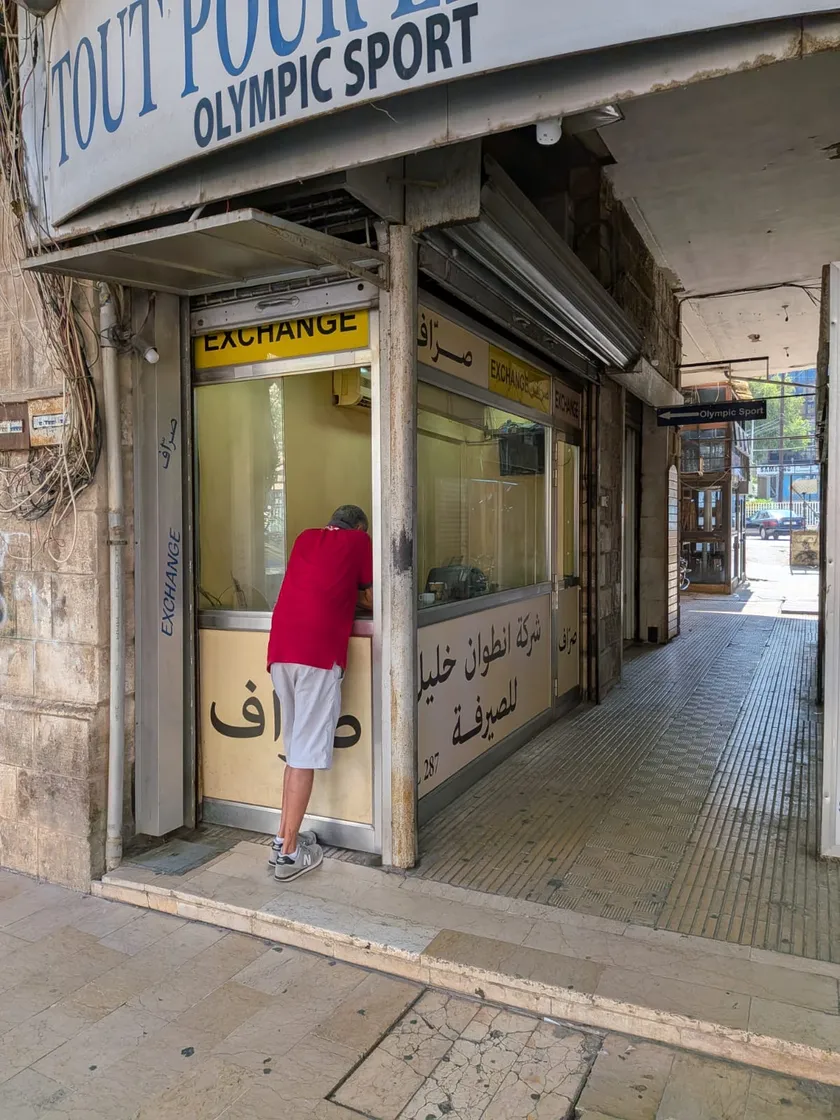
Syria's sarraf (money exchange) network: 5,000 to 10,000 agents, no digital rail. Saleem estimate.
Migrant workers send home about $250 (roughly AED 900) at a time. At documented rates, commissions of about 5% rising to all-in corridor costs above 20% (World Bank Remittance Prices Worldwide, Saudi Arabia to Syria), that is $12 to $55 of a single transfer absorbed in fees, and more at the reported extremes. The Saleem fee on the same transfer is $0; FX conversion applies where currencies convert.
Average transfer size: IFAD and UN DESA, $200 to $300 sent every one to two months.
paid in transfer charges every year across four of our focus markets. Saleem is designed to put that money back in the pockets of the people who need it most.
Derived: World Bank global average remittance cost, 6.36% of the amount sent (Remittance Prices Worldwide, Q3 2025), applied to roughly $122B of combined annual inflows to Pakistan, Egypt, Bangladesh, and Lebanon (sources below). Syria excluded: no reliable figure. Saleem fee is $0; FX conversion applies where currencies convert.
Annual remittance inflows from all sources combined, not single corridors. The GCC hub marks the sender corridor; sender corridors sit outside the eight receive markets. Marker size reflects relative inflow. Map data: Natural Earth (simplified). Sources: State Bank of Pakistan, Central Bank of Egypt, Bangladesh Bank, World Bank. Syria shown as an unsized estimate (dashed marker): flows are largely informal and no reliable current official figure exists.
The Solution
Stablecoins without smartphones. Inclusion without internet.
And the merchant is just another phone.
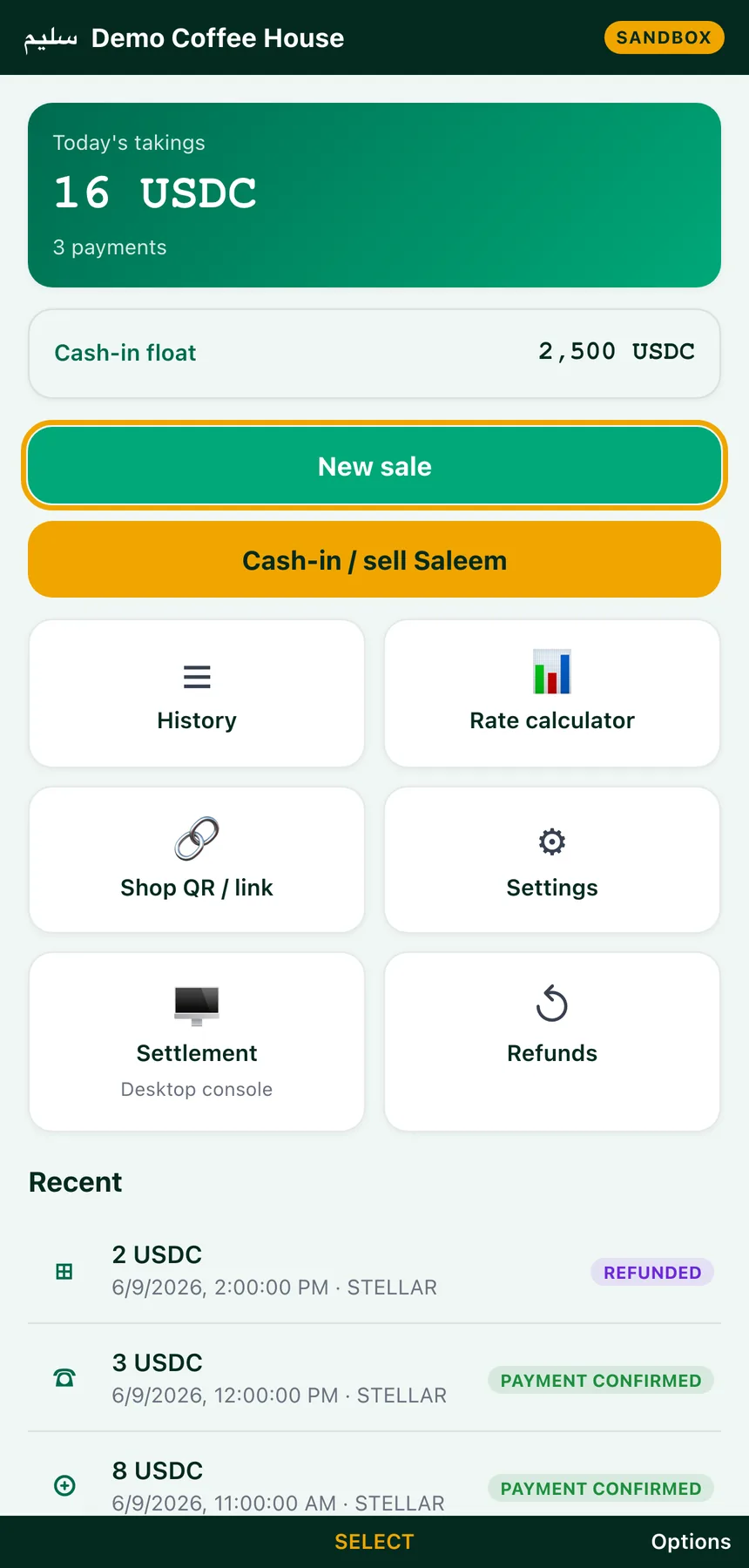
Any KaiOS or Android phone becomes the POS, no dedicated hardware. An optional dedicated terminal covers high-volume merchants.
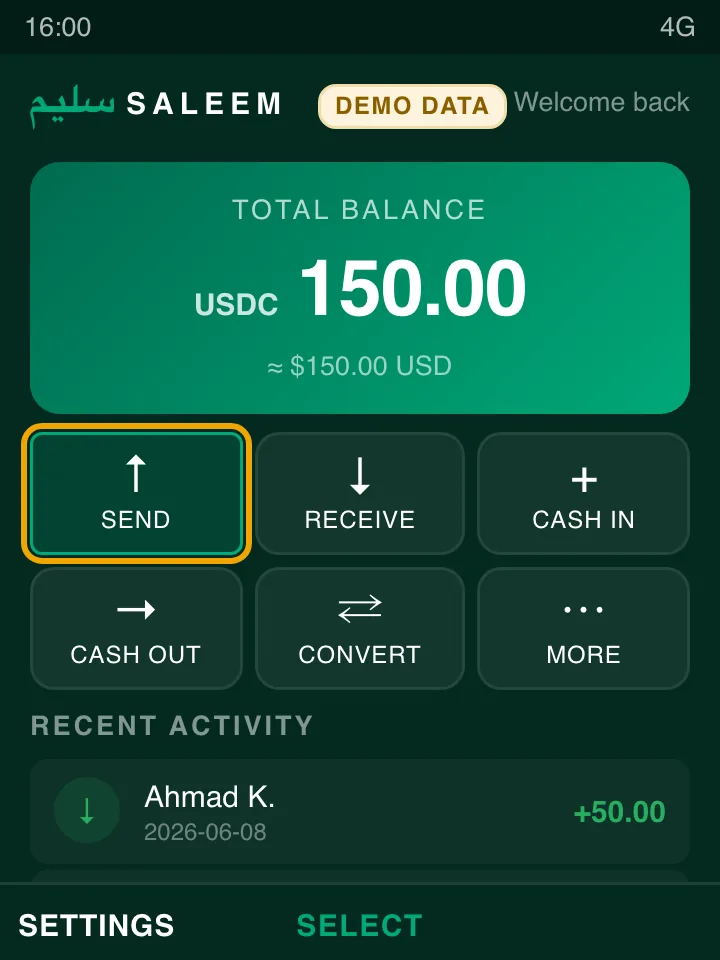
On KaiOS, one phone runs both the wallet and the merchant POS.
One wallet, presented as a ladder: three consumer tiers, two operator surfaces, and one interoperability layer. Every surface settles in stablecoins.
One wallet that grows with the customer, from a $12 handset to a smartphone.
USSD / STK
Stablecoin settlement
Vue.js App
Stablecoin settlement
React Native App
18 screens · Stablecoin settlement
Phone-as-terminal · KaiOS / Android
No dedicated hardware required; optional terminal for high volume
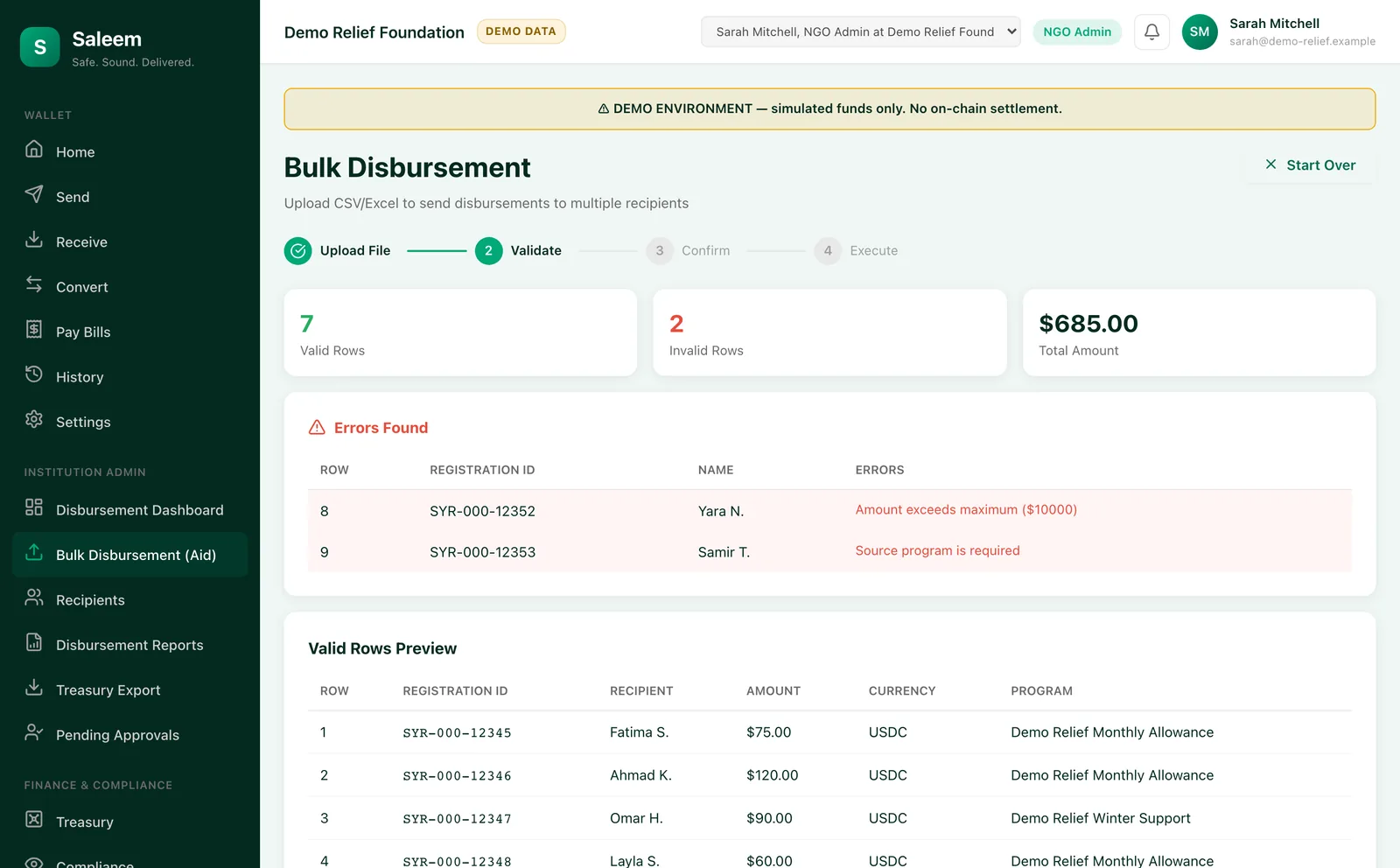
Tauri v2 Operator Console
21 desktop pages
WalletConnect v2
MetaMask · Phantom · ZenGo · Tether Wallet
One wallet across every device, settled on stablecoin rails with cross-chain bridging. End-user wallets run on DFNS MPC infrastructure. Custodial by design: no seed phrase to lose, recovery by phone and PIN. Regulated institutional custody is available as designed-in optionality.
Saleem extends the banks and telcos people already use to the last mile.
USSD → Blockchain
Dial *555#. Enter PIN. Settled in seconds.
Five revenue streams, none paid by the sender or the recipient: SaaS and API licensing, FX spread, bank revenue share, sarraf share, telco USSD revenue share.
No Saleem fee to sender or recipient; FX conversion applies where currencies convert.
Saleem takes no yield on customer balances. The ring-fenced Humanitarian SIM Allocation Fund receives a fixed share of commercial account setup fees plus 100% of any incidental yield, and funds provisioning and starting credit for humanitarian-priority SIMs. Riba-avoidance by design.
Stream mechanics and per-year projections in the white paper; per-market sensitivity and per-partner unit economics under NDA.
The hard part of humanitarian disbursement is proving where the money landed. Saleem settles through the same agents families already use, with a tamper-proof on-chain record from donor to recipient.
Pay staff and aid recipients without cash leakage, and with a verifiable record of where every payment lands.
Telcos already hold the customer relationship banks can't reach. Saleem turns the SIM into a financial product: new ARPU, no app-store dependency.
Where banking is thin, the SIM becomes the account. Receive, hold, cash out at the corner agent, on any phone.
Capture the remittance flow beneath the apps you already run, on the SIM the customer trusts.
Layer onto your app to reach every subscriber.
White-label Saleem as your own.
Why MNOs sign: New ARPU, near-zero churn, no app-store gate, and you keep the customer and the larger share.
Gateway architecture, integration paths, revenue-share economics, and partner-specific commercials. In the Telco Partnership Playbook, shared post-NDA.
28 banks mapped and tiered across our eight markets by digital maturity. Every bank can participate, from app-equipped to branch-only.
Has an app. Add stablecoin settlement and a USSD fallback.
Basic app. Add wallet, bill pay, merchant QR.
No app. Become their complete mobile banking layer, reaching everybody.
Recurring per-SIM SaaS architecture. One-time activation fee plus monthly recurring per active wallet, billed to the bank. Per-bank pricing and scenarios in the Banking Partner Analysis (post-NDA).
The bank keeps its customer relationship.
Syria · Pakistan · Egypt · Bangladesh · Lebanon · Ethiopia · Kenya · Somalia: the eight receive markets, holding 496M adults, of whom 293M have no bank account. 231M have neither a bank account nor a smartphone as their main device: the planning figure, and the midpoint of a bounded range, since the Global Findex Database publishes marginals rather than cross-tabulations. Adult and account data from the Global Findex Database 2025, surveys conducted 2024; Syria and Somalia carry Saleem estimates. Sender corridors, such as the GCC, sit outside the eight-market count. Per-market adults, unbanked and no-smartphone figures and corridor-by-corridor economics in the white paper.
Diaspora employers, BPOs, NGO field offices, and regional supplier networks pay people in countries where banking is broken or expensive. Saleem provides the corporate operator console, stablecoin disbursement rails and recurring payee management.
Staff and supplier payments, claimed as local cash at the nearest agent.
On-chain invoicing. Suppliers in Syria and Pakistan paid in hours.
Recurring payees for monthly batches.
Syria's informal hawala network is the country's real payment infrastructure: 5,000 to 10,000 sarrafs (money exchange agents) moving an estimated $1 to 2B annually. Both figures are Saleem estimates: no published figure exists. Saleem keeps the agent at the centre of the relationship while giving them tooling, commission tracking, and a settlement rail their incumbents cannot match.
Cash in, cash out. Commission on both legs.
Commissions settle on-chain in real time.
Compliance and sanctions screening built into the rail.
Integrate once. Reach the last mile across eight markets.
Six blockchains supported out of the box. Chainlink CCIP provides cross-chain bridging across EVM and Solana SVM for seamless asset movement between rails.
| Asset | Peg | Network | Issuer / Licence |
|---|---|---|---|
| DDSC | AED | ADI Chain | Issued by AEDC Stable Coin Network and Distribution L.L.C. Approved by the CBUAE to go live February 2026 as a Dirham Payment Token under the PTSR. Initiated by IHC and FAB, with Sirius International Holding. Backed 1:1 by AED reserves. |
| AEDZ | AED | EthereumSolana | Zand AED, issued by Zand Trust, a wholly owned subsidiary of Zand Bank PJSC. Approved by the CBUAE November 2025 as a Dirham Payment Token under the PTSR. Backed 1:1 by AED reserves in segregated accounts. |
| USDT | USD | TRONEthereumSolana | Tether. Recognised by the ADGM FSRA as an Accepted Fiat-Referenced Token, initially on Ethereum, Solana and Avalanche, extended December 2025 to further networks including TRON. |
| USDC | USD | EthereumStellarPolygonSolana | Circle. USDC is recognised by the ADGM FSRA as an Accepted Fiat-Referenced Token. Circle holds an ADGM FSRA Financial Services Permission as a Money Services Provider, granted December 2025. Circle is NYDFS regulated; USDC is MiCA compliant in the EU. |
| USDU | USD | Ethereum | Universal Digital Intl Limited, ADGM FSRA regulated (FSP No. 250089) to issue a Fiat-Referenced Token to Professional Clients only. Registered Foreign Payment Token Issuer with the CBUAE under the PTSR, January 2026. |
AE Coin, the first fully CBUAE-licensed Dirham Payment Token (December 2024), completes the AED panel, so the AED leg is not dependent on a single issuer. Regulatory status as published by each issuer. Verified August 2026.
Marks shown are the property of their respective owners and indicate technical support, not endorsement.
Three consumer tiers, two operator surfaces, one interoperability layer, all on one wallet core.
The full ladder, from RTOS feature phones to the desktop console, is shown in the Solution section.
Two providers: document IDV, biometrics, risk-tiered onboarding.
Four-way consensus: counterparty risk, sanctions, surveillance, analytics.
IVMS101 originator and beneficiary exchange on every settlement chain.
Tiered KYC applies, with limits scaled by verification level. Details available post-NDA.
Three institutional-grade wallet-infrastructure partners: covering end-user MPC, partner / NGO institutional settlement, and treasury-level multi-chain reserves.
Named vendor stack and integration architecture detailed in the white paper.
AES-256 encryption, SHA-256 integrity, jurisdiction-aware retention policies.
All four device tiers and the operator console built and demo-ready, pre-launch. TypeScript strict mode, zero errors. Independent penetration test and third-party security audit sit within production scope, ahead of go-live.
A six-tab compliance dashboard covers risk overview, KYC review and document vault, FATF Travel Rule transfer management, blockchain screening with four-way provider consensus, and a tamper-proof audit trail. Live walkthrough under NDA.
Saleem never sells, licenses, or transfers consumer data. Any future analytics are opt-in and consent-based.
An independent Data Protection Officer will be appointed ahead of launch, with board access. Lawful basis register and DPIA framework will be operational from day one.
Consent-based and cohort-level only. Every query is audit-logged. Data Subject Access Requests are honored within statutory windows.
Data Strategy 2026 published as the canonical reference document. Available on request.
Every audience that touches the rail gets a console scoped to its workflow, all on one Tauri v2 foundation.
Role-scoped consoles for merchant, sarraf, corporate, bank, and government, on one Tauri core. Live walkthrough under NDA.
Reach is measurable. Three mechanisms carry it: who gets an account, what the account becomes, and who pays for the ones that cannot pay for themselves.
Pakistan's Benazir Income Support Programme is issuing free SIMs to up to 10 million female beneficiaries and routing disbursements through SIM-linked wallets. For many of those women, a wallet reached through that channel is the first account they have ever held in their own name. That is the proof pattern for every market Saleem enters.
The same account that receives a first humanitarian payment later receives remittances, then pays merchants, then holds savings in a stable currency. One account across every step, on whatever handset the customer holds, with the compliance record compounding rather than resetting.
The humanitarian rail recovers cost rather than generating revenue. The ring-fenced Humanitarian SIM Allocation Fund receives a fixed share of commercial account setup fees plus 100% of any incidental yield, and funds provisioning and starting credit for humanitarian-priority SIMs. Zero-riba by design.
The same account carries every step. Nothing resets when a customer moves up.
The World Food Programme alone distributes more than $400 million a year in Syria through intermediaries that leave no digital audit trail. Delivering that digitally, auditable on-chain, with no Saleem fee to the recipient and FX conversion applying where currencies convert, is the clearest single statement of what this platform is for.
The Name
Safe. Sound. Delivered. One SIM at a time.
"Saleem means safe, sound, and whole."
Recognised across Arabic, Urdu, Pashto, Farsi, Turkish, and more, the name needs no translation. Saleem is a trust brand, not a tech brand.
Stablecoin regulation, telco distribution, and emerging-market operations.
A Chief Technology Officer and a Head of Compliance are secured, joining full time on close of the current round.
"Financial infrastructure that respects the dignity of every user, regardless of the device in their hand."
"Distribution is everything. We build where the telcos already are."
Documentation of our architecture, regulatory strategy, and go-to-market approach. Complete the form below and a member of our team will send the materials to you directly.
For partnership discussions and institutional inquiries.
5 Lanes Limited, ADGM registered, not FSRA licensed. Abu Dhabi, UAE.