Turn your wallet into a corridor

Your wallet already reaches every subscriber. Saleem connects it to institutional and cross-border payment flows through licensed partners.

Where it stops today

What changes

Value, measured your way: institutional payments landed, wallet activity, float, transaction volume, share of subscribers reached by basic phone.

Carry institutional payouts

Agency and payroll runs credited to your wallet by API, with a reconciliation file.

Six client surfaces are built and demonstrable against mocked services. The production backend, licensed-partner connections and independent security testing remain pre-launch work.

Land international value

Where the legal framework, licensed partners and settlement route permit it, value from abroad can land on the subscriber's existing number.

The exchange rate is set by the licensed partner, not by Saleem.

Run a licence-grade back office

Console, screening, records and exports on your infrastructure, in local currency; no new consumer app.

No new consumer app: the subscriber keeps the handset, the SIM and the number. Nothing to install, nothing to migrate.

How the channel carries a payment

Five steps, from the sending institution to the counter.

  1. InstitutionAn agency, a government programme or an employer sends a payment run
  2. SaleemEach payment is screened, routed and recorded, and credited to the operator's wallet on the number, or to Saleem's where none exists
  3. Telco channelThe operator's own menus carry the session to the subscriber, on SIMs already in the field
  4. SubscriberThe subscriber checks the balance, sends, spends or requests cash on the handset in hand
  5. Merchant or cash-outValue is spent at a Saleem merchant, or withdrawn at a licensed exchange house or agent

Who keeps what

What can be said today, and nothing beyond it.

You keep the subscriber and the wallet. Saleem provides the settlement layer, the payer console and the compliance record; the commercial arrangement is set per operator.

What the operator keeps

Who does what, and who answers for it.

Subscriber ownership

The subscriber, the SIM, the number and the wallet stay yours.

Custody

Recipient balances are to be held by a licensed custodian and accessed through Saleem's interfaces; keys do not sit on the handset. This is the target operating model at launch.

Channel role

The operator provides USSD, SIM Toolkit and the SIM estate as a channel. Licensed partners perform regulated money movement, custody, conversion and payout as required in each jurisdiction. Saleem provides instruction validation, screening orchestration, routing, records and reconciliation under the agreed operating model.

Compliance responsibility

Saleem answers for screening and for the record regulators require. The operator answers for subscriber identity and its own licence conditions.

Integration

Where the operator runs a wallet, Saleem credits it by API and the operator's own menus carry the session. Where it does not, short-code sessions route to Saleem's handler over a secure connection, and where SIM Toolkit is used the applet is provisioned over the air to SIMs already in the field. No core network change is required.
What exists today

Six client surfaces are built and demonstrable against mocked services. The production backend, licensed-partner connections and independent security testing remain pre-launch work.

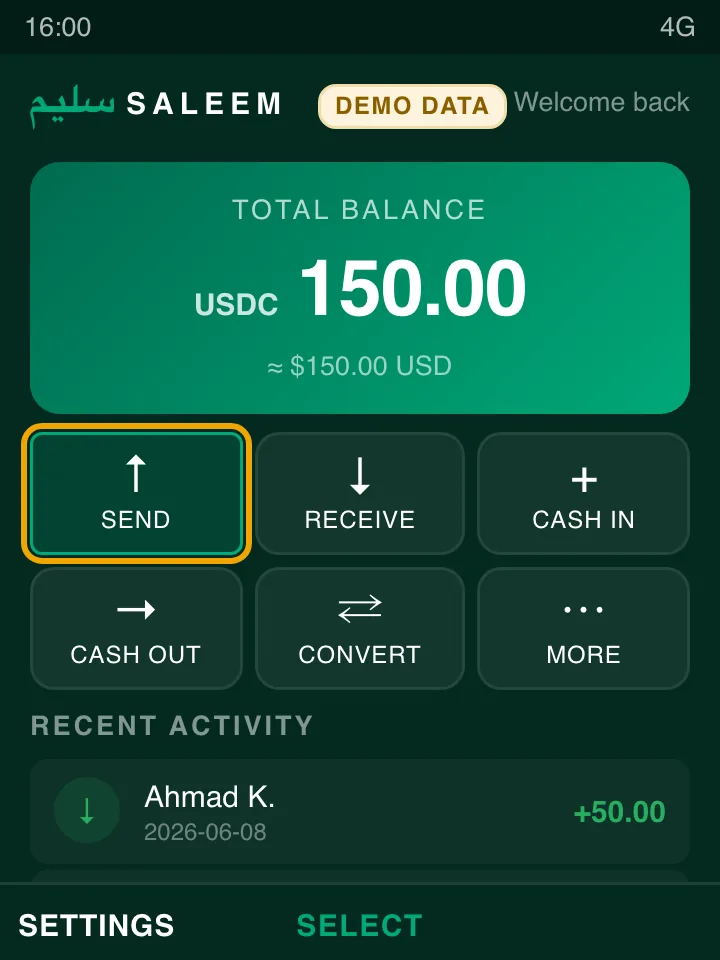
Saleem KaiOS feature-phone wallet home screen with balance card, demo data
The wallet on a feature phone

Six client surfaces are built and demonstrable against mocked services. The production backend, licensed-partner connections and independent security testing remain pre-launch work.

Talk to us about your wallet

Tell us which markets you run, which wallet your subscribers hold and what your short-code platform looks like, and we will scope the integration and the commercial shape together.

Talk to the team

Questions partners ask

All twelve questions